Darkness
Tsikal Studios, Seattle, 1989 (with other poets and members of the band idiophone)
This performance included a collection of poets and musicians in the middle of a gallery. The performance culminated in several songs, including an "operap" between Alan and the singer Maggie Bloodstone that was backed by Tom Larsen and Bien--all four of which performed occasionally as "idiophone." Tom Vail also played sax on one of the songs.What Goes Down Must Come Up
Pyramid Club, New York, NY, 1990
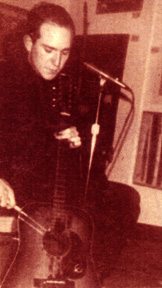 This show was a combination of media images about the body being co-modified and sold by pop culture. It included a musical rant by a white supremacist character, a poem recited in a shirt pinned with female images from both porno mags and Vogue and then covered in shaving cream, and a variety of pieces that used common words manipulated by a sampling keyboard to become alien sounds. This show included the premiere of "Barbie
and the Big Hole," a spoken-word piece about an attempt to make a human connection without a real body.
This show was a combination of media images about the body being co-modified and sold by pop culture. It included a musical rant by a white supremacist character, a poem recited in a shirt pinned with female images from both porno mags and Vogue and then covered in shaving cream, and a variety of pieces that used common words manipulated by a sampling keyboard to become alien sounds. This show included the premiere of "Barbie
and the Big Hole," a spoken-word piece about an attempt to make a human connection without a real body.Photo by Shani, 1990.
Three Songs About Food, Money, and War
Botanical Garden, Brussels, Belgium, 1990
During this piece, Alan balanced a flan on top of a small sampling keyboard, which turned French and English words about the world's food supply into distorted, rhythmic patterns. The piece was about how the world's food is dependent on technology for its growth, collection, and distribution, and how media can obscure very clear messages and calls for aid in the name of entertainment.The Alphabet of Savages
Dance on Capitol Hill, Seattle, 1991
The first major performance by Alan was also the first part of his "American Language" series, which comprises five performances in all. This show featured slides, props, a sampling keyboard, and a four-piece rock band, idiophone. The performance examined language--its origins, its ability to both heal and destroy culture, and its capability to totally obscure meaning. The performance featured two female dancers, several musical numbers with hand puppetry and overhead projections, and a revised Pledge of Allegiance; the piece concluded with a rock song called "I'm Not Your Baby!," which featured a mock-Madonna dance routine.TV or Not TV
Tugs, Seattle, 1992, and 911 Media Arts Center, Seattle, 1993
The second part of Alan's "American Language" series examined American television--first in the vaudeville-type environment of the Seattle nightclub Tugs, then using the movie screen at 911 Media Arts Center for larger video projections.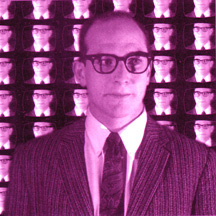 The show featured a cast of puppets on video, on-the-road travelogues shot by Alan and his video producer Robert Russell, and images grabbed from late-nite cable TV, to create a video-based landscape
for the show. The piece included cello, bass, percussion, harp, and keyboard accompaniment to provide a sometimes spooky aural landscape. This performance examined what is traveling through the wires and satellite dishes of a media-centered world. Can one find spiritual attunement while still grafted to the television? Featured the song "This Mai Tai Would Taste Better If I Had A Mouth," an audience-participatory ode to the
Gulf War.
The show featured a cast of puppets on video, on-the-road travelogues shot by Alan and his video producer Robert Russell, and images grabbed from late-nite cable TV, to create a video-based landscape
for the show. The piece included cello, bass, percussion, harp, and keyboard accompaniment to provide a sometimes spooky aural landscape. This performance examined what is traveling through the wires and satellite dishes of a media-centered world. Can one find spiritual attunement while still grafted to the television? Featured the song "This Mai Tai Would Taste Better If I Had A Mouth," an audience-participatory ode to the
Gulf War.Photo by John Hubbard, 1992.
Dancing With The Dead
911 Media Arts Center, Seattle, and Artists' Television Access (ATA), San Francisco, 1994
This piece, another installment of the "American Language" series, was an ode to Alan's friend Richard Hilton, who died of AIDS-related causes. What does it mean when somebody is gone? Why do we tend to remember only their saintly qualities, not their more human ones? And, more to the point, how does memory really work? This thought-provoking spiritual journey included video and slide imagery by Alan, Slugg Jello on cello, Jeri Francis on guitar, and choreography by Anne Cooper, who appeared as a masked skeleton figure. Erotic photographic imagery by Geoff Manasse was featured as a backdrop for the finale, a Patti-Smith-inspired version of the BeeGees' "Stayin' Alive." The performance featured the poem "Lazarus."Bitchy Bitch LIVE! (co-adapted, produced, directed, and acted in)
Adaptation of Naughty Bits, a comic by Roberta Gregory; originally co-adapted, produced, and directed for the 1995 Seattle International Fringe Festival, where the play won Best of the Fest, then co-adapted with Gaen Murphree and produced for the Theatre Off Jackson, Seattle, 1995
This play was adapted from Roberta Gregory's Naughty Bits, a Fantagraphics comic about Midge, a woman who endures a hellish array of everyday characters both at the office and home. An ensemble piece with terrific direction by Gaen Murphree and fantastic set design by Regan Haines and Alysoun Bond. Alan played "Nora" in both productions, a Bible-banging church-lady type.Unspeakable Love Acts
Dixon Place, New York, NY, 1996
Alan's one-man show, performed with saxophonist Harry Mann, looked at life and love lived through classified ads, adult bookstores, corporate bathrooms, and missed connections--people compartmentalized and compromised by their own sexual proclivities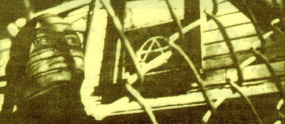 and hypocrisies. Slides of Times Square (before Disney took it over) and projections of porn stars and valentines underscored the loneliness of several characters, all played by Alan: an executive
obsessed with bathroom activities, a secretary with a secret yen for spirituality, a man getting his HIV test result, and a cretin who obsesses over any woman he sees. The performance included "Sexual Guilt Blues," a drag ode to one-night stands. This was another installment in the "American Language" series.
and hypocrisies. Slides of Times Square (before Disney took it over) and projections of porn stars and valentines underscored the loneliness of several characters, all played by Alan: an executive
obsessed with bathroom activities, a secretary with a secret yen for spirituality, a man getting his HIV test result, and a cretin who obsesses over any woman he sees. The performance included "Sexual Guilt Blues," a drag ode to one-night stands. This was another installment in the "American Language" series.
Photo by Dana Schuerholz, 1994.
Humor From The Apocalypse (short performance)
Benefit for Talent In Motion magazine, Cherry Lane Theatre, New York, NY, 1997
A short piece about construction and destruction in New York City, and how one man's apocalypse is another one's daily life. This performance was later incorporated into Obliviotopia as "Apocalypse Whenever.""Realness & Rhythms" reading series (two-time participant)
A Different Light Bookstore, produced by Emanuel Xavier, New York, NY, 1997 and 1998
This monthly reading series featured eight poets per event. At each show he was in, Alan read "tarot cards" (hand-picked before the show from those ubiquitous postcard kiosks found in record stores and bookstores) for the audience, often producing hilarious results. Alan also premiered several touching poems in this venue, such as "Disasters In Reverse."Obliviotopia
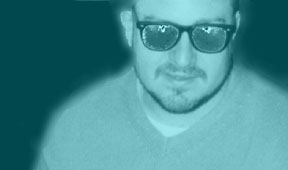
848 Community Space, San Francisco, 1999
This performance, the last produced for the "American Language" series, but actually written to be next-to-last in the series, is, at least on the surface, about a shamanic journey made through a never-ending suburbia on public transportation. The show included abundant slides of strip malls and parking lots under impossibly blue skies, a synthesized campfire song with wolves baying, a fire-and-brimstone preacher reading to his groupies from the Book of Revelation, a few Star Trek aliens that resembled Alan, digitized video of San Jose gridlock, a Midwesterner giving visitors a bus tour of San Francisco's Castro neighborhood, and even footage of Alan's childhood backyard. It was a rambling, non-linear, and even sentimental tone poem about growing up next to a freeway in California, using a mix of trance music and sound effects produced by Pamela Z to back up the piece. Songs included "Bus Through Suburbia".Bear-A-Go-Go!
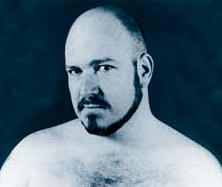
Jon Sims Center for the Arts, San Francisco, 1999, and National Queer Arts Festival, "Best of AIRspace" series, San Francisco, June 2001
Alan's seven characters illuminated stereotypes of fat and furry gay men--from the obese 19-year-old stuck in suburban hell, to the Internet geek afraid of being judged in the physical world, to a big player in the "Bear" universe, where being rotund and hirsute is a surefire way to get both laid and fetishized. The show, which pulled no punches, looked at how one subculture marginalizes another one through the filter of being a chubby among skinnies. Two furry go-go dancers lap-danced for the audiences during Alan's costume changes. The poem "Holiday at the Baths" concluded the show.Photo by Liliana Rodriguez, 2001.
Touched by a Monster
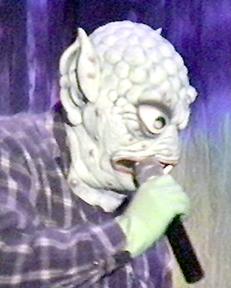
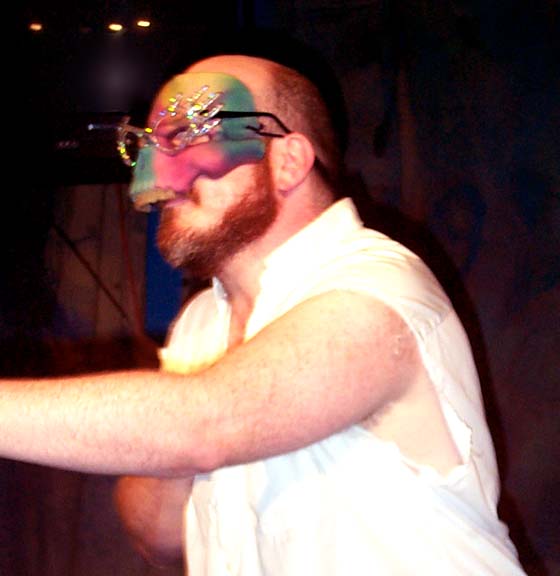
Zeitgeist Multi-Disciplinary Arts Center, New Orleans, LA, Western Front, Vancouver, B.C., MadLab Theatre, Columbus, OH, and Surf Reality, New York, NY, 2002; commissioned by Western Front, Vancouver, B.C.
"Monster movies," "the serial killer living next door," "the living dead"--they exist among us in real life and in media form! But do real monsters exist separately from us? Or are they simply our own needs, fears, and desires in disguise? Touched by a Monster explored with abandon how people project their fears and desires into monsters all around them. From a twisted fairy tale about "monstracide," to a murderous washed-up movie star, to drag-racing hellions on urban streets, to terrorists competing with pornography for the public's attention, to the cinematic "death of the monster," this is a macabre musical homage to the monster in all of us. Several songs from the performance appear on Alan's CD "4 Seasons in a Day."Bad Gays!
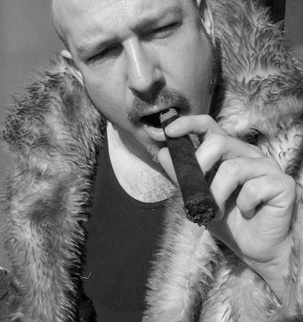
Club Eros, Jon Sims Center for the Arts, San Francisco, 2005
Alan's latest comedic performance piece contained a stable of characters, all played by Alan, who discuss their lives while "doing time" in an urban bathhouse. In stark contrast to the so-called "good gays" at the heart of the gay-marriage issue that continues to pop up in contemporary American discussion, Alan's characters are not the marrying kind. Alan's characters go to the heart of what it means to be sexual and beyond society's reach, at least for the hours spent inside the baths.Photo by Julienne Givot, 2005.
CD Release
Video Stills From Performances
Home
For more information about Alan Reade's work, click here to e-mail him.
© Alan Reade, 2011